Yes, you can use my blog in a paper or report
Sunday, November 28, 2010
EXTRA CREDIT
I have always enjoyed communication, so prior to enrolling in RTF 305, I had already been keeping up with two blogs. One blog is an account of my personal life whereas the other is a new year's resolution to keep myself accountable in practicing acts of kindness daily. Being able to discuss concepts further in depth and apply them to examples has been a positive aspect of using a blog in RTF 305. However, sometimes it took a lot more effort than I expected to find examples to match the material we were learning. The blog was easy to maintain, so I did not encounter any trouble technologically speaking. The 6th Blog Prompt, which required us to discuss examples of shots Prof. Ramirez-Berg described, was interesting but also challenging since we had to find a film that had not been discussed already. We also had to know the film well enough to tie the plot into the rationale for each shot. I would recommend using a blog in a future course simply because it is a much easier way to track students' learning progress. I would suggest that all blog prompts be posted on the main blog because blog prompts get lost when they are emailed. I would also suggest that they be posted at the same time each week to have more structure.

Sunday, November 21, 2010
Globalization
Globalization is defined as "the process of increasing interconnectedness among nations, cultures, and people." It reduces differences between nations so that communication and ideas flow seamlessly across cultures.
Cultural imperialism takes place when some countries have substantially greater influence over others through the media. It is a form of globalization in communications media since differences in culture diminish when one culture overpowers the other by dominating its film, television, music, news, and information sectors.
This phenomenon is evident in CNN's pervasive presence in television. A US cable news channel founded by American Ted Turner, CNN's global counterpart CNN International is available in over 212 countries and territories. Though the channel headlines international news, it is clear that ultimately American ideals and culture influence the opinions voiced on shows. Because CNN International is so widely broadcasted across the globe, this is an example of how America dominates other countries in the news. Henceforth, America is able to manipulate how people perceive certain issues and incidents.
Sunday, November 7, 2010
iPod nano - New way to nano
Apple has always produced powerful ads that have wide appeal. This Apple ad is titled "iPod nano - New way to nano." The tagline is a play on the word "nano," referencing both the product and its compact size. As an upgrade to the previous generation of iPod nanos (as shown below), these nanos sport a completely different interface.
Fifth Generation

Sixth and current generation
Like many of Apple's commercials, this one taps into the "aesthetic sensations" appeal. This appeal uses radiant colors to make the product appear more desirable. It employs soothing visuals to give the audience a positive viewing experience, helping them develop a positive image of the product as well. Apple presents the iPod nanos in radiant colors that attract your attention. They compliment the color of each nano in the commercial with each person's outfit, showing the iPod to be an extremely fitting accessory that is naturally essential in daily life. By appealing to the consumers' senses, Apple increases the desirability of the iPod nano.

Like many of Apple's commercials, this one taps into the "aesthetic sensations" appeal. This appeal uses radiant colors to make the product appear more desirable. It employs soothing visuals to give the audience a positive viewing experience, helping them develop a positive image of the product as well. Apple presents the iPod nanos in radiant colors that attract your attention. They compliment the color of each nano in the commercial with each person's outfit, showing the iPod to be an extremely fitting accessory that is naturally essential in daily life. By appealing to the consumers' senses, Apple increases the desirability of the iPod nano.
Sunday, October 31, 2010
Three-Act Structure in Mean Girls

The three-act structure includes the introduction, the complication, and the resolution. The introduction usually takes up the first 30 minutes of the film while the complication develops in 30-60 minutes. The resolution takes place in the last 30 minutes of the movie. The plot line basically involves a series of riskier and riskier decisions or mini-climaxes that lead up to the final climax and resolution.
Mean Girls is a comedy about high school social cliques and how they affect girls. The introduction sets up Cady Heron as a new high school student who had just moved from Africa to Evanston, IL. Having been home-schooled for 16 years, she was unfamiliar with the social customs of high school life. Cady meets Janis Ian and Damien, who teach her the social ropes and become her friends. One day, the school's popular trio Regina, Gretchen, and Karen (the Plastics) invite Cady to sit at lunch with them every day. The movie hits its first plot point when Janis and Damien convince Cady to spy on Regina and pretend to be her friend around 12 minutes in. As Cady continues this friendship, the movie transitions into the complication around minute 28:17 when Cady realizes how "evil" Regina is and plans to take down Regina with the help of her two friends.
The complication is the middle portion of the movie, which lasts anywhere from 30-60 minutes. During this time, Cady's hate for Regina gradually builds up, and she starts to lose her identity to the one that Regina invented for her. The second mini-climax occurs when Cady finally destroys Regina's reputation and alienates her from Gretchen and Karen approximately 54 minutes into the film. Cady becomes the new "queen bee," and things finally get out of hand at her party when her love interest Aaron as well as Janice and Damien confront her about the person she had become: Regina George.
The resolution comes in and the plot thickens as Regina shows her Burn book to the principal and accuses Cady, Gretchen, and Karen for writing it. Regina also exposes the book to the rest of the high school, and the girls begin to physically assault one another after reading the rumors and gossip written in there. Thereafter, the movie climaxes when Cady owns up to writing the Burn book at minute 69, and problems begin to be resolved. Cady makes up for her mistakes by competing with the math athletes, and she makes a speech at the Spring Fling Dance to apologize for her actions. The movie concludes with the main cast finding their niche in high school while playfully introducing the new junior "plastics."
Picture Source: http://www.impawards.com/2004/posters/mean_girls.jpg
Sunday, October 24, 2010
Mini-Resolutions in Community

An important characteristic of an episodic sitcom is its use of mini-resolutions to conflicts that arise in each episode. There are generally several mini conflicts that exist either between characters, within a character, or between a character and a social force. These conflicts are important because they set up the plot line for that episode as they are eventually resolved by the episode's conclusion. They serve as a lesson for both the characters as well as the audience.
A show that has this characteristic is Community, which is a show that revolves around the lives of seven students in a spanish study group at a community college. Each episode begins with a few issues to start off the story. Take the latest episode as an example. Shirley asks Abed to make a christian film to promote her church. Out of pride, Abed makes a movie in which he parodies Jesus, insulting Christianity. Shirley is outraged, and they are at odds until the end of the episode, when Shirley decides to be Abed's scapegoat and Abed finally makes the movie Shirley had requested. All the while, Pierce, a man in his 50's, starts hanging out with a group of irresponsible, elderly students in spite of the study group's protests. Finally, when Pierce and his new gang end up in a "car accident," Pierce realizes that those people aren't his true friends, and the study group welcomes him back. These minor conflicts and resolutions are crucial in driving the plot for each episode.
Picture Source: http://l.yimg.com/l/tv/us/img/site/05/73/0000070573_20100827105403.jpg
Sunday, October 17, 2010
Gladiator
Gladiator is a film in which the protagonist General Maximus Decimus Meridius is betrayed by the Roman Emperor's son Commodus, who murders his own father to take the throne. Commodus murders Maximus' wife and son and reduced him to slavery to prevent him from defying Commodus' authority. Maximus gains recognition with the crowd as a gladiator to avenge the murders of his family and the true Emperor Marcus Aurelius.
This clip takes place after Maximus successfully defeats his opponents of chariots and archers and is introduced to Commodus.
It is an intense scene that employs many close-ups to reveal what each character--predominantly Maximus, Commodus, Lucilla, and Spencer--are feeling. When Maximus first takes off his helmet, the revelation of his identity alerts Commodus and Lucilla. The close-ups show the intimidation, fear, anger, and jealousy in Commodus' eyes, helping the viewer understand how Commodus is conflicted between executing Maximus on the spot and showing mercy to gain the crowd's approval. One can see that Lucilla is worried for Maximus, and she longs for him to live. This further develops the emotional connection between them that leads Lucilla to help Maximus escape later on.
The medium shots of Maximus always show him standing in front of many other gladiators, showing that he is their leader and that they support him in his quest for vengeance. The gladiators admire him, and their willingness to have his back is evident later on as they sacrifice their lives to help Maximus escape as well. On the other hand, the medium shots of Commodus portray him a few Roman soldiers behind him in the beginning of the clip. Later, the soldiers move so that none of them are in the shot, ironically hinting at a false loyalty. This foreshadows Commodus' eventual downfall.
The long shots in this clip isolate Maximus and the gladiators, showing them to be the elite and crowd favorite. Towards the end of the arena scene, it shows the crowd cheering while they walk away in triumph. This emphasizes the power of the crowd and how Maximus is able to use his popularity to earn a fight to the death with Commodus.
Sunday, October 10, 2010
The Star System
Once Hollywood became the focal point of film industry, major studios discovered that it was necessary to develop new ways of attracting audiences. They soon realized that certain actors and actresses were able to command the attention of viewers regardless of what the film was about. This led to the coining of the star system, which was and still is a film studio's use of stars' popularity to promote its movies.
This type of promotional technique led to the association of actors and actresses with certain genres of film that they often starred in. The studios had tremendous control over what types of film were being produced since the audience mainly paid to see the stars rather than analyze the plot. Hence, the studios could produce more B movies and make a significant profit from them as long as a big name celebrity was in the film.
An example of the star system in effect is the acting career of Judy Garland. As a vocally talented actress, Garland was often casted in musical films. Viewers who enjoyed musical numbers would flock to see her films such as The Wizard of Oz, Summerstock, and The Harvey Girls. The clip below is from The Wizard of Oz, where Judy Garland sings the number "Somewhere Over the Rainbow."
http://www.youtube.com/watch?v=QhzbzwPNgXA
Sunday, October 3, 2010
"All in the Family" vs. "Modern Family"
"All in the Family" and "Modern Family" are both situational comedies that deal with conflicts involving family relationships and societal issues in its time. In both shows, a dominant, patriarchal character is present in the form of Archie for "All in the Family" and Jay for "Modern Family." Jay and Archie are middle-aged family men who hold traditional American values. Their introduction and resistance to liberal values such as homosexuality provide comic relief. "Modern Family" also imitates a "mockumentary," interviewing family members during the show to provide insight to their thoughts.
Whereas "All in the Family" revolves mainly around Archie and his family, "Modern Family" revolves around three families to reflect different generational problems in America today. "Modern Family" reflects diversity in both culture, age, and sexuality, casting a vietnamese baby with homosexual parents, a Columbian wife and son, and teens of different ages. On the other hand, "All in the Family" maintains an all-white, heterosexual cast to reflect the everyday family during its time.
The issues that arise in one family are different from the issues that arise between three. "All in the Family" mainly deals with issues that arise due to Archie's prejudice or obstinate values. Since Archie's daughter is married, it does not place much emphasis on how to be a positive role model to one's children. On the contrary, "Modern Family" includes four teenagers, so it deals with all sorts of issues such as growing up and parenthood. It is also more culturally diverse, so the show often focuses on the clash between Latin American and Caucasian culture.
Both shows effectively communicate their message in ways that the audience in their time can relate to.
Sunday, September 26, 2010
The Influence of Technology on Radio
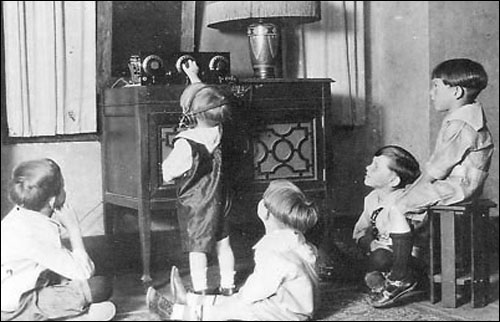
Radio communication began as a "wireless telegraph" created by inventor Guglielmo Marconi in 1896, used to carry messages in Morse code. As the years progressed, Manager of American Marconi David Sarnoff "proposed a plan of development which would make radio a 'household utility' in the same sense as the piano or phonograph." He envisioned it to be "designed in the form of a simple 'Radio Music Box' and arranged for several different wavelengths, which should be changeable with the throwing of a single switch or pressing of a single button," (Straubhaar 161). This vision was eventually actualized as technology allowed the radio to be accessible to most homes.
Because the new radio technology was utilized by the majority of the population, this propelled the commercial and entertainment aspects of the radio industry during the 1920's. The prevalence of radios in households led manufacturers to advertise their products on air and entertainers to reach a larger audience. This advancement in technology was crucial to the economic and social aspects of the radio industry as industries sponsored programs and listeners received not only entertainment, but also news. "People were so enthusiastic about the new medium that they accepted the ads without much objection, and a commercial advertising-based model was soon firmly entrenched," (Straubhaar 162-163). The excitement that came with new technology definitely helped the radio system flourish in its early stages.
Picture Source: http://www65.statcan.gc.ca/acyb05/acyb05-06/img/acyb05-06_0001.jpg
Sunday, September 19, 2010
Social Learning Theory

The social learning theory maintains that people learn new behavior by observing one another's actions. If such actions yield positive results, then people are more inclined to imitate those behaviors. In the context of media, viewers of movies or television shows may identify themselves with the cast and model their lives after the fictional characters'. When these characters are rewarded for their illegal or irresponsible behavior on screen, viewers are further encouraged to mimic them.
"Weeds" is a comedy-drama television series that promotes such observational learning because it rewards rather than punishes corrupt behavior. It follows the lives of suburban housewife and recently widowed Nancy Botwin and her family. Having just lost her husband Judah to death by heart attack, the series begins with Nancy dealing marijuana to support her family. After several seasons of trial and resolution, Season 5 concludes with Nancy's son Shane murdering an adversary with a croquet mallet.
The following video is the preview for Season 6, which premiered on August 16th:
The trailer reveals that, after Shane kills Pilar, the Botwins are on the run as they take on their new identities as the "Newmans." The scenes show the "Newmans" attempting to lead normal, "law-abiding" lives with a humorous twist. At the conclusion of the video, Nancy resorts back to dealing. Instead of weed though, she deals hash.
Rather than facing authorities and turning Shane in for the murder, the Botwins evade the law for a fresh start. Though they profess to wanting to lead normal lives, they eventually return to their previous crimes. By masking these felonies with humor, the show makes crimes such as dealing/smoking weed, murder, and aiding and abetting seem acceptable to society. It downplays the gravity of misdemeanors by showing how much fun the Botwins are having and how they are able to live above the law. The show also encourages viewers to smoke weed by making marijuana seem prevalent and easily obtained. The fact that the Botwins always somehow escape ill consequences only further encourages the audience to imitate them and reap the "benefits" depicted in the show.
Picture Source: http://smallscreenscoop.com/wp-content/uploads/2010/07/weeds-season-6-poster.jpg
Sunday, September 12, 2010
Hegemony in Commercials
Hegemony is an ideology asserted by dominant groups in a society in order maintain power. While this may be confused with obtaining control through brute force, in Hegemony, power is actually achieved through consensus. It does so by making certain ideas a part of everyday life. Through media, people are influenced to embrace the presented perspectives as the social norm.
The concept of hegemony gives me insight into the following Calvin Klein commercial by showing me how companies exploit the physical qualities of men to their advantage.
This commercial is a part of Calvin Klein's X Underwear campaign. Throughout the commercial, the video features close-up shots of attractive, topless men asking whether the audience wants to see their "bleep." Toying with their underwear waistband, the men are presented as confident and provocative. The slogan "X marks the spot" also emphasizes the male organ and highlights the men's masculinity. By including men of different ethnicities such as African American, White, Asian, and Hispanic, the underlying consensus is that all men who wear Calvin Klein underwear naturally have the build and charm that these men have. Because people associate being tough and being a pimp with being a "real man," the commercial targets both males and females from a wide age range, thereby establishing Calvin Klein X Underwear as the underwear that any "real man" should purchase. This is therefore an extremely successful use of hegemony by Calvin Klein.

Picture Source: http://static.thehollywoodgossip.com/images/gallery/calvin-klein-ads_445x333.jpg
Sunday, August 29, 2010
Why RTF 305?
Hello, World! :)

My name is Ivy, and I'm from Houston, TX.
First off, congratulations to Modern Family for winning the 2010 Emmy's Award for Outstanding Comedy! This is definitely one of my favorite televisions shows, and I'm ecstatic for its win.
Moving on, as an RTF major, I am taking this course mainly because it is the prerequisite to all the other courses in RTF. But of course, my reasons go beyond that. I have always had a deep interest in music, film, and the like. Because information is now largely transferred through digital means, media consumption has increased dramatically in recent years. The current generation is radically dependent on media, so by taking this course, I hope to better learn its role in our society and how I can make better use of it during days to come.
Here's a recent example of me learning and making use of media:
Picture Source: http://static.tvfanatic.com/images/gallery/modern-family-poster.jpg
Video Source: http://www.facebook.com/video/video.php?v=1430939663868&ref=mf
Subscribe to:
Comments (Atom)