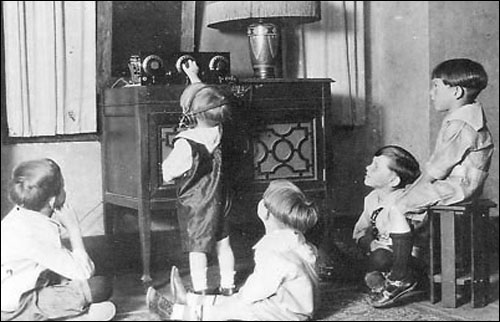
Radio communication began as a "wireless telegraph" created by inventor Guglielmo Marconi in 1896, used to carry messages in Morse code. As the years progressed, Manager of American Marconi David Sarnoff "proposed a plan of development which would make radio a 'household utility' in the same sense as the piano or phonograph." He envisioned it to be "designed in the form of a simple 'Radio Music Box' and arranged for several different wavelengths, which should be changeable with the throwing of a single switch or pressing of a single button," (Straubhaar 161). This vision was eventually actualized as technology allowed the radio to be accessible to most homes.
Because the new radio technology was utilized by the majority of the population, this propelled the commercial and entertainment aspects of the radio industry during the 1920's. The prevalence of radios in households led manufacturers to advertise their products on air and entertainers to reach a larger audience. This advancement in technology was crucial to the economic and social aspects of the radio industry as industries sponsored programs and listeners received not only entertainment, but also news. "People were so enthusiastic about the new medium that they accepted the ads without much objection, and a commercial advertising-based model was soon firmly entrenched," (Straubhaar 162-163). The excitement that came with new technology definitely helped the radio system flourish in its early stages.
Picture Source: http://www65.statcan.gc.ca/acyb05/acyb05-06/img/acyb05-06_0001.jpg


